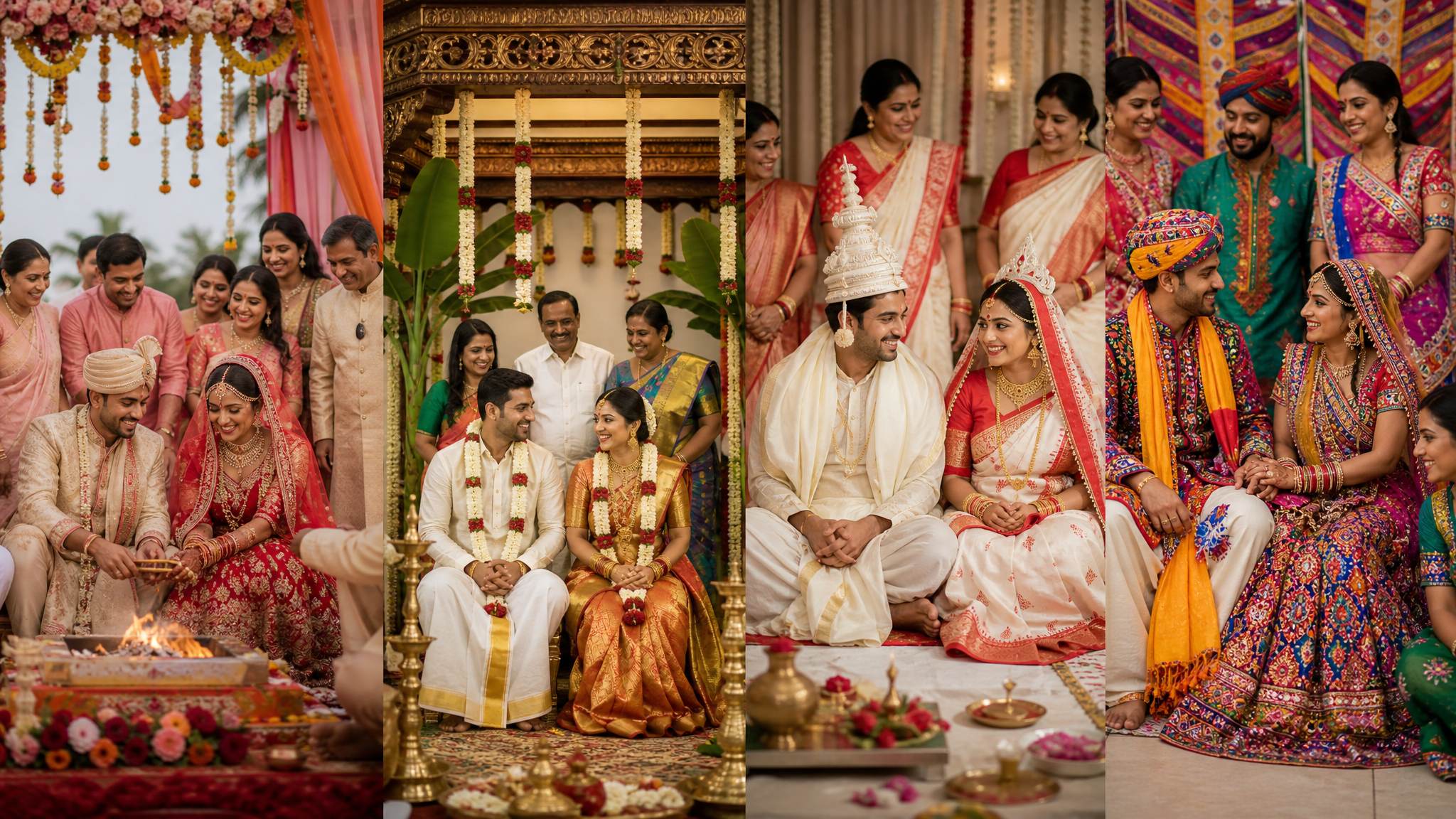
Indian Wedding Cultures, Rituals, Families, and Styles: A Respectful Regional Guide
Indian weddings are not one single ceremony. They reflect many religions, languages, regions, communities, family histories, and personal choices. A Punjabi wedding may look very different from a Tamil wedding, a Bengali wedding, a Muslim nikah, a Christian church wedding, a Jain ceremony, or a Parsi celebration. Even within one community, families may combine traditional rituals with a modern schedule, a destination venue, or a celebration in another country.
This guide is a practical overview rather than an attempt to define every Indian community. Ritual names and meanings can vary by region, family, faith, and language. Couples should confirm the details that matter to them with their families and religious or community elders.
Why Indian wedding culture is so diverse
India’s wedding traditions have developed through centuries of regional and religious history. Geography affects food, clothing, music, venue design, and the order of celebrations. Faith affects the ceremony itself. Families influence guest lists, rituals, hosting responsibilities, and the way a wedding is introduced to the wider community.
Migration has added another layer. NRI families may plan a ceremony in the USA, Canada, the UK, Australia, or the Gulf while keeping selected traditions from a home state or district. Some families translate rituals for guests, shorten multi-day events, or combine ceremonies from both partners’ backgrounds.
Common wedding styles across India
Indian wedding styles can be grouped by more than appearance. A couple may choose a religious ceremony, a civil ceremony, a community tradition, a small family wedding, or a large multi-day celebration. Some weddings are intimate and simple; others include several events with hundreds of guests.
- Traditional community wedding: The family follows familiar rituals, clothing, food, and music from its region or faith.
- Inter-regional wedding: Both families contribute customs, creating a ceremony that reflects two languages, communities, or states.
- Interfaith wedding: The couple and families decide which religious, civil, or cultural elements can be included respectfully.
- Destination wedding: The celebration moves to a venue outside the family’s home city, often with a smaller guest list and planned events.
- City or diaspora wedding: The couple adapts Indian traditions to a hotel, community center, temple, gurdwara, church, mosque, or other venue abroad.
- Simple family wedding: The focus stays on the ceremony and close relatives rather than a large event schedule.
None of these styles is more authentic than another. Authenticity can mean preserving a family ritual, understanding its meaning, and making an informed choice about what to include.
North Indian wedding traditions
North Indian wedding celebrations may include events such as roka or engagement, mehndi, haldi, sangeet, a baraat, the wedding ceremony, and a reception. The exact sequence differs across Punjabi, Hindi-speaking, Rajasthani, Gujarati, Kashmiri, Himachali, Haryanvi, and other communities.
In many Hindu ceremonies, the couple may sit around a sacred fire and take pheras or make vows according to the family’s tradition. Families may take active roles in welcoming the baraat, participating in songs, preparing the bride or groom, and hosting guests. In Punjabi weddings, music, bhangra, dhol, family dancing, and colorful pre-wedding events are often important, but every family chooses its own scale and style.
Family roles in North Indian celebrations
- Parents and elders may guide introductions, ceremony decisions, and hosting responsibilities.
- Siblings and cousins often help with music, dance, guest coordination, and informal celebrations.
- Maternal relatives may have specific roles depending on the community and family custom.
- Both families may exchange gifts, blessings, food, and formal introductions.
South Indian wedding traditions
South Indian weddings include many distinct traditions from Tamil, Telugu, Kannada, Malayalam, Kodava, and other communities. Ceremony details can vary significantly even within a state. Common elements may include a formal welcome, family blessings, decorated mandapam, music, silk clothing, floral arrangements, and rituals connected to the couple’s faith and region.
In many Hindu South Indian ceremonies, the couple may exchange garlands, the groom may tie a thali or mangalsutra according to family custom, and the couple may take part in rituals guided by a priest. Telugu weddings may include distinctive pre-wedding and ceremonial customs; Tamil weddings may feature events such as nichayathartham, nalangu, or oonjal in some families; Kerala and Karnataka celebrations may use their own clothing, food, music, and ritual patterns.
Family roles in South Indian celebrations
Families may organize the muhurat, guest hospitality, clothing, food service, music, and ritual materials. Elders often bless the couple, while siblings and cousins help coordinate the many small details that make a multi-event wedding work.
East Indian wedding traditions
East Indian weddings include many regional styles from West Bengal, Odisha, Bihar, Jharkhand, Assam, and neighboring communities. Bengali Hindu weddings may include rituals such as aiburo bhaat, gaye holud, bor jatri, saat paak, mala badal, and sindoor daan, although names and practices vary by family. Odia, Assamese, and Bihari celebrations have their own clothing, food, music, and ceremony traditions.
The bride and groom’s families may participate in welcoming guests, preparing ritual items, arranging meals, and carrying out blessings. Family storytelling, regional songs, and food can be as important to the wedding experience as the central ceremony.
Respectful planning for East Indian customs
Do not assume that one Bengali, Odia, Assamese, or Bihari ritual represents every family. Ask which traditions the couple wants to preserve, which relatives should lead them, and how the ceremony should be explained to guests from another region.
West Indian wedding traditions
West Indian wedding styles include Gujarati, Maharashtrian, Rajasthani, Goan, Sindhi, and other community traditions. Gujarati celebrations may include garba, dandiya, a pithi ceremony, and family rituals around the mandap. Maharashtrian families may include sakhar pudha, halad, antarpat, and regional wedding customs. Rajasthani and Marwari celebrations may be known for distinctive clothing, music, hospitality, and extended family participation.
These examples are not fixed rules. Families may shorten the schedule, combine events, or adapt the celebration for a venue abroad. The meaning of a ritual should be discussed with the people who will perform it rather than copied from a generic checklist.
Punjabi wedding styles and rituals
Punjabi weddings may include roka, engagement, mehndi, haldi, sangeet, chooda or kalire customs in some families, the baraat, milni, laavan or other ceremony elements depending on faith, and a reception or family gathering. Sikh Anand Karaj takes place in a gurdwara and includes the four laavan; Hindu Punjabi families may follow a Hindu wedding ceremony with their own regional customs.
Family participation often includes relatives helping with music, clothing, guest hospitality, ceremony preparation, and introductions between households. A Punjabi wedding can be vibrant without being identical to another Punjabi wedding. Families should discuss the guest list, budget, rituals, food, and expectations early.
Hindu wedding ceremonies
Hindu wedding rituals vary by region, sampradaya, language, family practice, and the priest guiding the ceremony. Possible elements include engagement, family blessings, ganesh puja, mehndi, haldi, kanyadaan or family participation, the sacred fire, pheras or saptapadi, mangalsutra, sindoor, and post-wedding blessings.
Not every Hindu family includes every ritual. Some couples choose a short ceremony, a civil registration alongside a religious ceremony, or a bilingual explanation for guests. The couple and families should confirm the ceremony order with their officiant.
Sikh wedding ceremonies
A Sikh Anand Karaj is held in the presence of the Guru Granth Sahib at a gurdwara or appropriate setting, with the couple walking around the Guru Granth Sahib during the four laavan. Families may also hold events such as engagement, mehndi, jaggo, sangeet, or reception gatherings, depending on personal and regional custom.
Respectful planning includes learning venue rules, arranging head coverings and appropriate clothing for guests, and speaking with the gurdwara or officiant about the ceremony requirements. Cultural celebration and religious ceremony should be treated with care rather than reduced to decoration.
Muslim nikah and walima traditions
Muslim weddings in India include many regional and cultural forms. The nikah is the marriage contract and includes requirements such as consent and witnesses according to the couple’s tradition and legal context. Celebrations may include mehndi, family gatherings, nikah, walima, regional clothing, music where appropriate, and community hospitality.
Practices differ among Sunni, Shia, Bohra, Mappila, Kashmiri, Hyderabadi, Bengali, and other communities. Families should speak with the imam or authorized officiant about religious requirements, documentation, and the way the event should be conducted.
Christian weddings in India
Christian weddings in India may take place in a church, chapel, or other approved setting and may include vows, scripture readings, hymns, prayers, rings, family blessings, and a reception. Goan, Anglo-Indian, Kerala Christian, Northeast Indian, and other communities have distinct music, clothing, food, and family customs.
The couple should confirm church requirements, premarital preparation, documentation, and the role of witnesses with the church or officiant. A reception may combine Indian clothing and food with Christian ceremony traditions.
Jain, Buddhist, Parsi, and other traditions
Jain, Buddhist, Parsi, and other Indian communities have their own marriage customs, ceremonies, prayers, family roles, and food traditions. Some couples combine community rituals with civil registration or a modern reception. The correct approach is to ask the relevant family elders and religious officiant rather than assuming that a Hindu or North Indian format applies.
India’s wedding culture also includes many tribal, regional, and local traditions that deserve their own careful treatment. A responsible guide can introduce patterns, but it cannot replace the knowledge of the community celebrating the marriage.
How families can plan across cultures
| Planning area | Questions for both families | Helpful approach |
|---|---|---|
| Ceremony | Which rituals are essential, optional, or new to one family? | Ask the officiant to explain the order and meaning. |
| Language | Which guests may need translation or a short explanation? | Use bilingual programs or a trusted family speaker. |
| Food | Are there religious, regional, allergy, or dietary needs? | Confirm menus early and label important dishes. |
| Families | Who will host, welcome guests, and manage decisions? | Assign responsibilities without assuming one family will do everything. |
| Budget | Which events, clothing, travel, and vendors matter most? | Agree on priorities before deposits are paid. |
Indian wedding clothing and visual styles
Wedding clothing may include sarees, lehengas, salwar suits, sherwanis, kurta-pajamas, dhotis, mundus, veshtis, regional turbans, jewelry, dupattas, and family-specific accessories. Colors and silhouettes vary by region, religion, event, season, and personal taste.
Clothing should be comfortable for the ceremony and respectful of the venue. Couples planning in the USA may need to arrange alterations, specialist draping, turban tying, jewelry security, and weather-appropriate layers in advance.
Indian wedding music, food, and hospitality
Music may include dhol, bhangra, garba, folk songs, film music, classical performances, devotional singing, or a carefully selected contemporary playlist. Food may reflect Punjabi, Gujarati, South Indian, Bengali, Hyderabadi, Goan, Kashmiri, or another family tradition.
Hospitality is often central to Indian wedding culture. Families may welcome guests with food, gifts, blessings, and personal attention. A smaller wedding can still be deeply hospitable when responsibilities are shared realistically.
How PunjabiRishtey fits into the journey
PunjabiRishtey helps Indian, Punjabi, Sikh, and NRI families begin the matchmaking stage before wedding planning starts. Families can explore Punjabi matrimonial profiles, review USA matrimonial options, read the membership information, and register a profile.
The platform can help people discover a possible match. The couple and families should then discuss cultural expectations, rituals, location, budget, and boundaries with the people who will actually lead the ceremony.
Frequently asked questions
What are the main types of Indian weddings?
Indian weddings may be Hindu, Sikh, Muslim, Christian, Jain, Buddhist, Parsi, or part of another community tradition. They also vary by region, language, family practice, and whether the celebration is religious, civil, or combined.
Are all Indian wedding rituals the same?
No. Rituals can differ between states, communities, religions, families, and even siblings. Confirm the ceremony with the couple, elders, and officiant.
Who should decide which rituals are included?
The couple should have meaningful input, while families and religious or community leaders can explain traditions and requirements.
How can two families combine different cultures?
List the important rituals from both sides, identify where they can be combined, and agree on the ceremony order, language, food, clothing, and family roles together.
Can Indian weddings be planned in the USA?
Yes. Many families adapt Indian wedding styles to USA venues, local vendors, guest travel, and community facilities. Confirm the venue’s rules and book specialist vendors early.
Final takeaway
India’s wedding cultures are best understood as a living collection of regional, religious, and family traditions. The most meaningful wedding style is the one that respects the couple, explains the rituals, includes families thoughtfully, and makes room for both heritage and personal choice.
Leave a Reply